Meet the Makers
Eight stalls, four counties, one rule: the person who makes it is the person who sells it. We spent a season visiting every seller on Famica Market to understand what the maker-first rule actually does to the food, the craft and the prices.
The rule that shapes everything
Every seller on Famica Market trades under one condition that is written into the seller agreement before anything else: the person named on the stall is the person who made — or directly made possible — what the stall sells. It sounds like marketing until you see it enforced. A preserve maker who buys in wholesale marmalade and re-labels it is not a preserve maker. A knitter who outsources to a factory and calls it handmade is not a knitter. The rule exists because the entire premise of a family market — online or under a roof — is proximity: you should be able to ask who made this, and get a true answer.
That proximity changes behaviour on both sides. When Rachel Ashworth of Hedgerow Preserves answers a question about pectin, she answers about her own pans, her own fruit and her own lemon supply — not a brand script. When Nia Bevan of Fernwood Pottery lists a batch of twelve mugs, the photographs are of those twelve mugs, because she took them the morning they came out of the kiln. The buyer’s trust is not in a platform; it is in a person whose name and county sit at the top of every listing.
It also changes prices, and it is worth saying plainly: maker-first goods are not cheap. A £28 mug or a £6.50 jar of jam looks expensive against a supermarket shelf until you price in what it replaces. The supermarket jar contains fruit grown for yield, processed at scale, with setting agents to guarantee uniformity. Rachel’s contains about seventy grams of fruit per hundred, picked ripe within thirty miles of her kitchen, cooked in numbered batches of forty. The £1.80 difference is not margin. It is the difference between those two supply chains.
A day in the Mendips: baking to a capped bakery
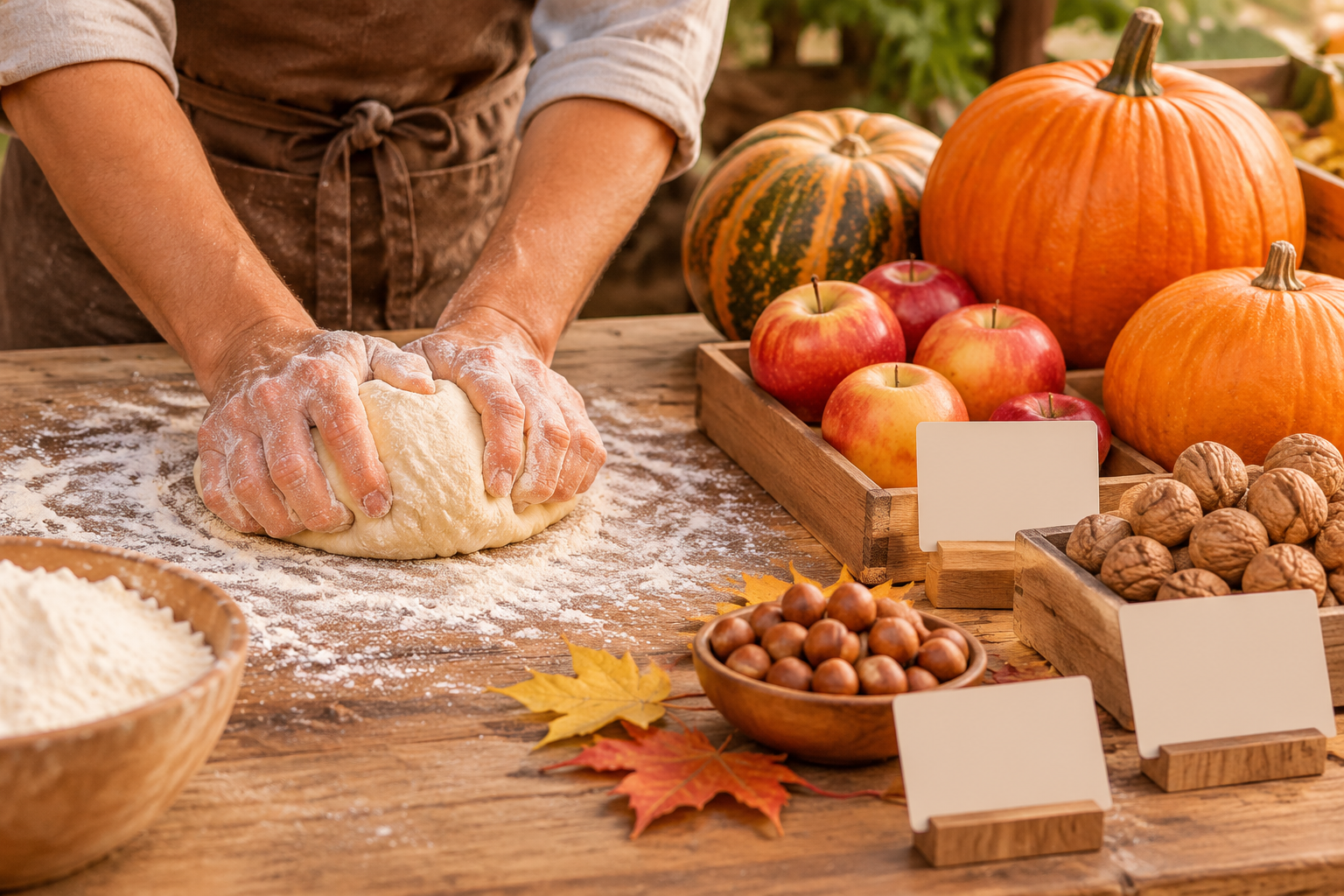
Crust & Crumb Bakery works out of a converted barn with a wood-fired oven and a starter named Doris. Tom and Priya — the two-person entirety of the company — mix on Monday afternoons, prove overnight, and bake from four in the morning on Tuesday, Thursday and Saturday. By seven most weeks, the day’s flour is gone.
That last part is deliberate, and it is the part visitors find hardest to understand. The bakery caps production at what its flour allocation and its bakers can genuinely sustain. ‘Better to sell out than bake a tired loaf’ is written on the barn wall, and it is not decoration. An eighteen-hour prove cannot be rushed by hiring; a second mixer would need a second Priya, and there is only one. So the Famica listing opens Sunday evening, fills through the week, and closes. Buyers who want a loaf for the weekend learn the rhythm inside a month.
Capped production is a policy choice with a cost: growth. The bakery could probably triple output with a second oven, a bigger barn and a shift pattern. It would also stop being the thing it is. ‘We did the maths,’ Tom says, ‘and the maths said we’d be running a small factory with a wood oven in the lobby. The oven would know. Bread would know.’
Traceability you can drive in an afternoon
Looped & Bound’s supply chain fits in a car journey. The Brodie sisters buy fleece from six Border and North Country flocks, have it graded and spun at a family mill twenty miles from the croft, and drive over twice a season to choose colours from the cones in person. Every finished piece carries the tag of the flock that grew it.
Compare that with the usual knitwear chain — fleece shipped to a mill, spun and dyed to forecast, knitted in a factory three time zones away, branded, shipped again — and the difference is not romance, it is accountability. If a batch of peat beanie wool pills badly, Morag can stand in the field where the fleece was clipped and have a conversation about it before the weekend. There is no importer to blame, no spec sheet that mysteriously changed.
Ed Carwyn at Timber & Twine runs the same loop with trees. Storm-felled hardwood comes from estates within the Welsh Marches; each board’s listing names the county it grew in. Offcuts become butter knives; shavings go to a neighbour’s smokehouse. ‘Very little leaves as waste,’ he says, ‘because waste is just material I haven’t met yet.’
What the maker-first rule asks of buyers
Honesty cuts both ways. A maker-first market asks buyers to accept variability as information, not defect. Nia’s oat glaze varies batch to batch because wood ash is agricultural, not industrial — the listing says so, with photographs of the actual batch. Chocolate harvests end and are not blended forward to keep a bar on the shelf. Jam batches sell out and the season moves on.
It also asks buyers to read. The listings that repay attention carry real numbers: fruit content per 100 grams, burn time measured rather than marketed, wool provenance by flock, price paid to cocoa cooperatives printed on the wrapper. None of this is small print. All of it is the product.
In return, the market offers something the high street has mostly surrendered: a producer who is reachable. Message Dale End Dairy about a wedding truckle and the reply comes from the dairy, not a contact centre. Ask Copper & Cacao which bar to give a coffee-drinker and Marcus will write you a paragraph, because he has roasted every batch himself and has opinions he cannot wait to share.
That is the season’s conclusion, and it holds across all eight stalls: proximity is not nostalgia. It is a quality system with people instead of paperwork — slower, smaller, more expensive, and measurably better at the only thing a market is supposed to do, which is put the maker’s work directly in the buyer’s hands.
What onboarding actually checks
Because the maker-first rule does the market’s quality work, onboarding does the rule’s work, and it is more physical than most applicants expect. A food maker’s visit — or video walkthrough, for the distant counties — covers the kitchen, the registration paperwork and the allergen flow: where ingredients come in, where finished stock waits for dispatch, and where the 14-allergen panel on each planned listing comes from. The Food Hygiene Rating is verified against the FSA public register rather than taken from a screenshot, and the local authority named on the seller page is the one that actually issued it.
For craft makers, the check is of making capacity: enough bench, wheel or machine to produce what the listing calendar promises, and photographs of work in progress rather than a portfolio of finished pieces. Ed Carwyn’s onboarding visit was four hours in the Welsh Marches workshop, mostly spent looking at the drying stack of walnut that becomes next autumn’s boards. ‘They wanted to see the wood I hadn’t made anything of yet,’ he says. ‘That’s when I knew the market was serious.’
The final stage is the listing build itself, and this is where most delays happen. Photographs must show the actual batch — not a representative shot from a previous season. Batch sizes, lead times, allergen panels and care instructions are written with the maker in a single working session, because a listing that the maker did not help write tends to promise things the maker cannot deliver. The first listing goes live only when the maker can point at every line on it and say, truthfully, that they wrote it together.
None of this is fast, and that is the point. Eight to twelve new sellers a year is not a growth target the market struggles to hit; it is the number that survives this process. The wait-list of applications held for the next seasonal window is the market’s real inventory, and everyone running it would rather have your application in that pile than your goods on a listing that quietly breaks the rule the whole market stands on.
More from the Journal
 How it works
The Seasonal Market Calendar
A family market runs on the year’s own clock. Here is the season-by-season structure behind Famica Market’s listings and events — what appea…
 Food safety
Allergen Guidance for Market Buyers
How allergen information works on Famica Market: what the law requires, what our sellers must state on every listing, how to read it, and wh…